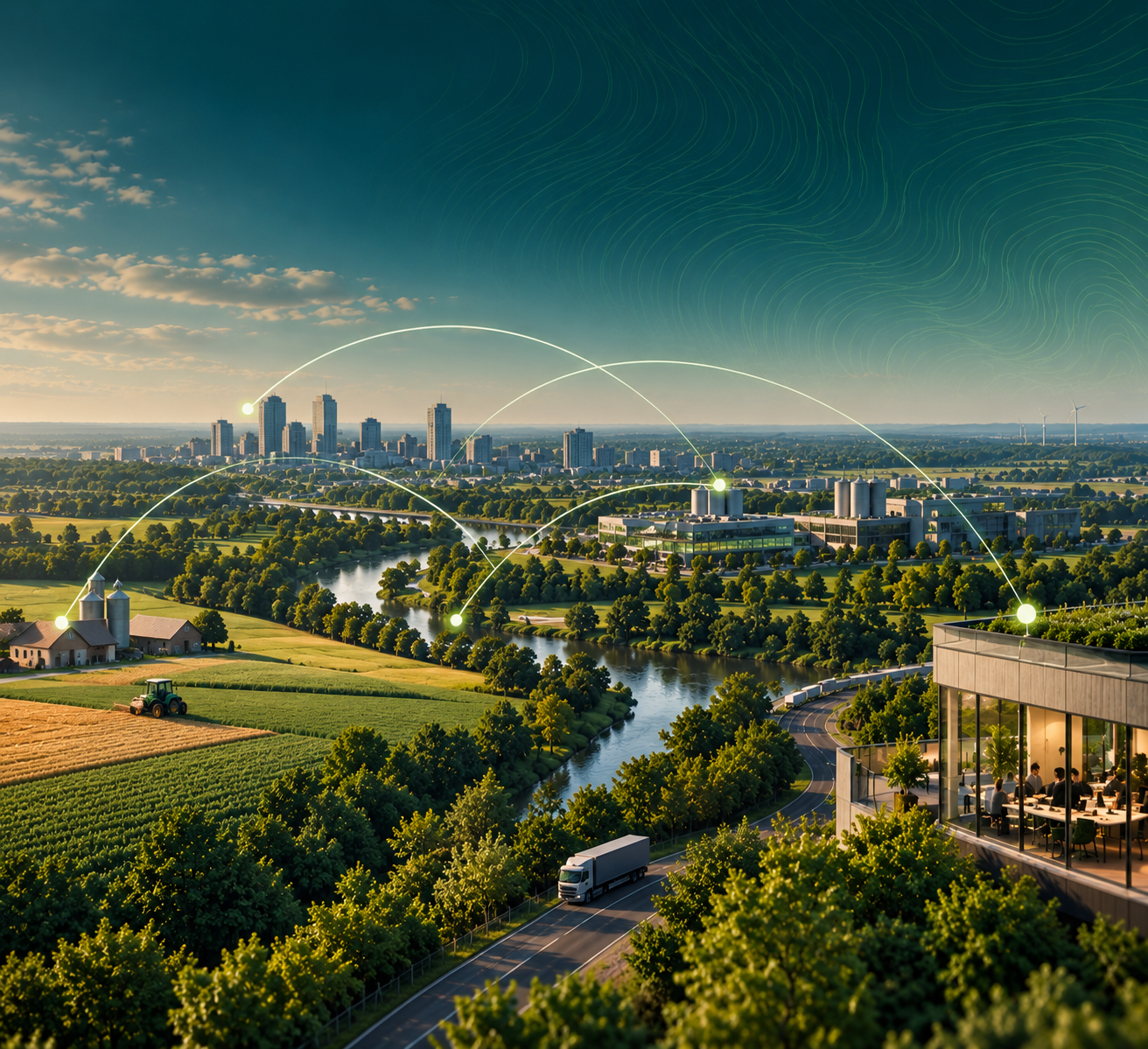
How regenerative business models can turn environmental restoration into long-term business value.
Economic transformation
Why delaware believes the next economic transformation will be regenerative
Most companies invest in technology to become more efficient. delaware's investment in Earth+ was driven by a different logic: growth today depends on the ability to operate within tightening resource limits, less predictable supply chains and rising sustainability expectations. For Thierry Bruyneel, Partner Ventures by delaware, and Matthias De Wannemaeker, Director at delaware, the collaboration reflects an opportunity to explore how environmental restoration can become part of the next phase of economic transformation.
Looking beyond carbon
Bruyneel has seen no shortage of sustainability startups over the years. Many focus on helping organisations measure emissions, improve ESG reporting or manage carbon credits. He believes many of those solutions address part of the challenge, without fundamentally changing how businesses create value. "What attracted us was their ambition to build an economic model in which environmental restoration creates business value," he says.
De Wannemaeker admits that he initially viewed Earth+ through a much narrower lens himself. "My first impression was that this was mainly a carbon credit story," he says. "That was the obvious entry point. Once I became involved, I realised carbon credits are only one element within a much larger vision."
He describes Earth+ as an organisation developing commercially viable regenerative business models. That broader vision is reflected in initiatives such as Greentripper+, which connects organisations with local regenerative projects, and Earth+ Scan, the company's digital platform for large-scale environmental monitoring. "Once you understand that bigger picture, you're discussing how businesses might operate differently in the future."
When sustainability reshapes the business
Bruyneel sees the same evolution in conversations with delaware's customers. Environmental performance is rarely the starting point. Customers are far more concerned with how they can strengthen the long-term resilience of their business. Sustainability becomes relevant because it increasingly shapes those strategic decisions.
That thinking aligns naturally with several strategic initiatives already underway within delaware. Factory of the Future focuses on helping organisations rethink production and operations. Resilience explores how businesses can remain successful in a rapidly changing environment. Earth+ complements both by investigating how regenerative value chains can become commercially viable.
"There are many organisations that genuinely want to become more sustainable," says De Wannemaeker. "The difficult part is translating those ambitions into concrete business reality. That's where Earth+ becomes interesting. The discussion moves beyond reporting or compliance efforts and asks what new opportunities emerge when you redesign the way value is created."
For Bruyneel, that distinction matters because lasting change depends on economic logic. "If sustainability remains something organisations do because regulation requires it or because subsidies make it viable, growth will always be limited. Businesses invest when they see opportunities to strengthen their position. That's why creating new value is so important."
More than an investment
Although delaware became involved through Ventures by delaware, both interviewees are quick to point out that the investment itself was only the beginning. The relationship has gradually developed into a partnership in which both organisations contribute expertise that the other could not easily build on its own.
Earth+ brings expertise in regenerative business models, while delaware contributes decades of experience helping organisations translate ambitious ideas into scalable business solutions. "Our role certainly includes building the platform," says De Wannemaeker. "But its real value lies in enabling new business models. Whatever organisations build on top of it, they need a digital foundation they can trust and that can evolve over time."
Just as important is the exchange of knowledge that has developed during the collaboration. delaware is learning about industries and business models that fall well outside traditional technology projects, while Earth+ benefits from decades of experience helping organisations transform their businesses. Bruyneel also sees delaware's customer network as an important asset. It creates opportunities to connect organisations that are wrestling with similar questions and may ultimately benefit from working together. "Technology is only one part of the equation. Bringing together organisations that recognise the same challenge is equally important."
A partnership built around complementary strengths
That exchange has broadened the conversation on both sides. The focus has shifted from technology alone to how new business models can succeed in practice. De Wannemaeker believes those conversations have become one of the most valuable aspects of the partnership. "We constantly challenge each other. Sometimes it's about technology. Sometimes it's about whether customers will actually adopt an idea."
Bruyneel recognises the same dynamic. Throughout his career, he has seen that successful innovation rarely depends on a single organisation. "Our role has never been limited to delivering technology," he says. "We've always tried to connect people with complementary expertise. Over the years we've built strong relationships across manufacturing, agriculture and the food industry. Those connections become valuable when you're trying to bring together organisations that each hold part of the solution."
For both men, that ability to build ecosystems is becoming increasingly important. The challenges businesses face today are often too broad for one company to solve in isolation. Regeneration is a good example. It involves farmers, manufacturers, technology providers, financial partners and customers, all of whom influence different parts of the value chain. Creating lasting impact therefore depends as much on collaboration as it does on innovation.
Shared values create a strong foundation
De Wannemaeker describes the collaboration as remarkably pragmatic. Assumptions are questioned, and both teams are willing to adapt when new insights emerge. He sees very little hierarchy in those discussions. Instead, people focus on finding workable solutions and moving projects forward. "There is a real willingness to experiment," he says. "Nobody assumes they already have the perfect answer. We learn from each other, test ideas and keep improving them."
Bruyneel sees the same mindset reflected in Earth+'s long-term ambitions. The organisation is trying to build an economic model that can continue to create value over many years. That perspective aligns closely with delaware's own culture.
"We've always believed that successful businesses are built for the long term," he says. "That means investing in ideas that may take time to mature, but that ultimately make organisations stronger and more resilient."
Defining success
Neither Bruyneel nor De Wannemaeker measures success by the growth of the platform alone. They are far more interested in the businesses that emerge around it and the opportunities those businesses create for others.
Bruyneel wants to see regeneration become part of the way businesses create value. If organisations can build commercially successful models around it, he believes the environmental benefits will follow naturally.
That belief is closely tied to his broader view of value creation. "You first have to create value before you can distribute it," he says. "If businesses become stronger because they adopt regenerative models, everyone benefits. Companies grow, local economies become more resilient and positive environmental impact follows from the same activity."
That belief explains why delaware invested in Earth+, and why both Bruyneel and De Wannemaeker see regeneration as a business opportunity in its own right.
Get in Touch